- XML
- Legal Tech
- Data Formats
- Software Engineering
I Thought XML Was Old. Legal Tech Hadn’t Moved On
I barely learned XML at university. Then I started working with legal documents and found it quietly carrying real work.
I thought XML was one of those things I had already learned—and mostly left behind.
At university, we covered the basics. A few tags, a little structure. In the projects I remember, JSON was usually the format we reached for.
Then I started working around legal documents.
Suddenly, XML was everywhere.
Not because anyone was trying to bring back an old technology. In the work I saw, XML was already built into how legal documents were structured, exchanged, and processed. I had learned enough XML to recognize the angle brackets, but not enough to understand why it had stuck around.
So, What Is XML?
XML stands for Extensible Markup Language. It is a way to describe information using tags that give data a visible structure.
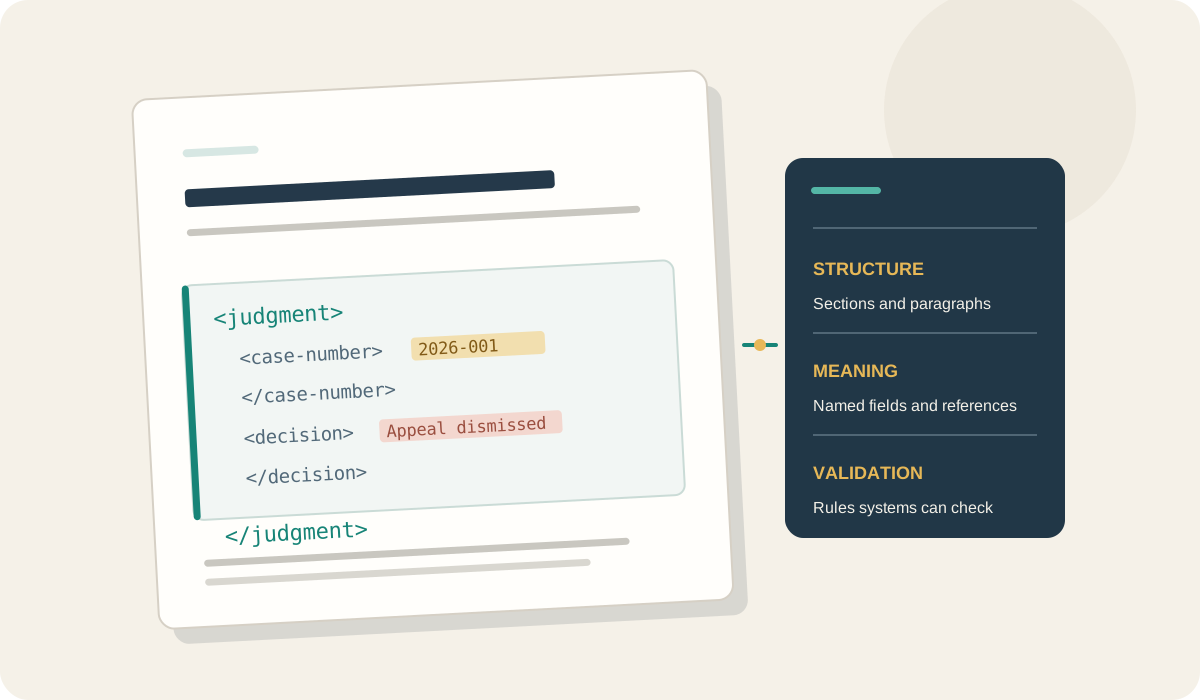
Imagine a judgment represented like this:
<judgment>
  <case-number>2026-001</case-number>
  <decision>Appeal dismissed</decision>
</judgment>
The tags tell a system that this value is a case number and that one is a decision. The document is still text, but its parts have names and relationships that software can inspect.
Real legal-document formats are much richer than this tiny example. They can describe sections, paragraphs, references, dates, parties, and other details in a consistent way.
Why Does Legal Work Use It?
Legal documents are not just blobs of text. Their structure matters. A heading is different from a paragraph. A paragraph may need a stable identifier. A reference may point to another part of a law or another document.
XML makes that structure explicit. With agreed vocabularies and validation rules, different systems can exchange documents and check whether they follow the expected shape.
For example, Akoma Ntoso is an OASIS standard that defines an XML vocabulary for parliamentary, legislative, and judicial documents. It gives institutions a shared way to represent document structure and metadata.
That does not mean every legal system uses the same XML format. It means XML can be a foundation for formats designed around the needs of a particular domain.
A Very Short History
XML did not appear out of nowhere. It grew from SGML, an earlier markup standard used for complex documents and publishing.
The W3C formed an XML working group in 1996, and XML 1.0 became a W3C Recommendation on February 10, 1998. The goal was to make structured documents easier to use and exchange on the web while keeping the flexibility that made markup useful.
So yes, XML is older than many of the tools we use every day. But old does not automatically mean irrelevant.
XML Didn’t Disappear. I Just Stopped Looking.
JSON is concise and convenient for many web APIs. XML can be more verbose. If all you need is a small object moving between two services, XML may not be the simplest choice.
But in document-heavy work, explicit structure, validation, references, and established standards can matter more than terseness. Once organizations, tools, and processes depend on a format, replacing it is not just a matter of picking the newer-looking option.
I thought XML was a basic topic from class. Work showed me it was also part of the infrastructure behind documents people rely on.
Maybe that is the lesson: the technologies we hear about most are not always the ones doing the most important work.
XML is old. No argument there.
But companies still earn millions building products and services around legal-document workflows—and XML can be part of the machinery underneath. It helps systems keep documents structured and moving between tools.
XML may be old. The business around keeping it useful is very much alive.
How did this land?
A tiny signal is enough—no account needed.