- AI
- Document Processing
- Software Engineering
From Complex Documents to Reliable Data
A practical lesson in reliable document automation: keep AI focused on interpretation, then use code to validate and transform the result.
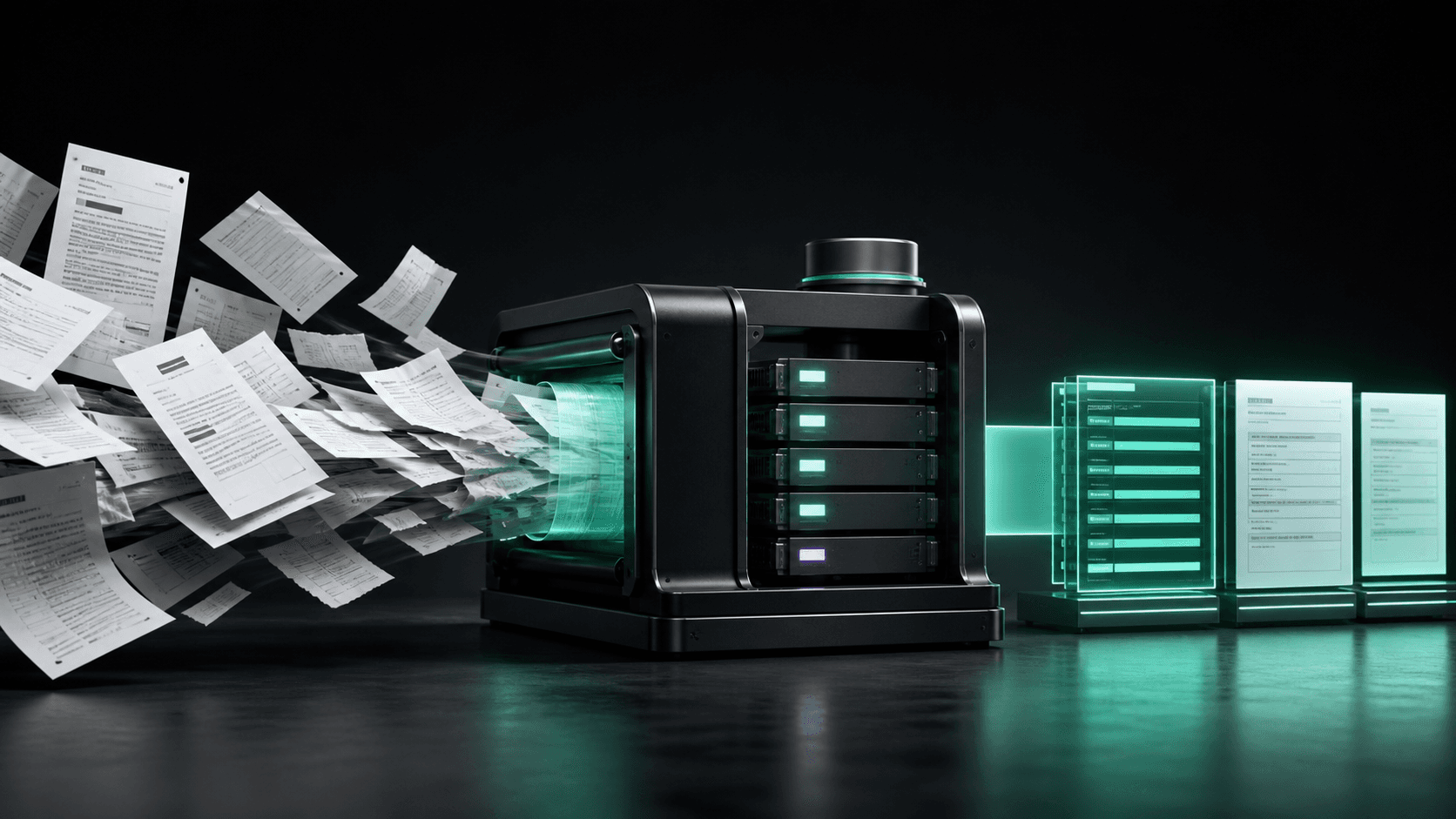
Document conversion can sound simple: read a file, extract information, and return structured data.
Real documents rarely follow one perfectly consistent pattern. The same information can appear in different places, edge cases can change what matters, and another system may require an exact output format.
Working on a document-processing workflow taught me an important lesson: giving an AI system every possible rule at once can make it less reliable, not more.
When one prompt has too much to do
My first instinct was to put the rules and examples together and ask the AI to handle the entire task. As the instructions grew, the system had more context than it needed for any one document. It sometimes mixed cases or returned something that looked right but did not meet the required structure.
The issue was not simply finding better wording. The task itself needed clearer boundaries.
More instructions do not automatically produce more reliable results.
Give AI the relevant context
A more focused workflow provides only the guidance that applies to the current document. That gives the AI a narrower job: interpret the content and identify the information that matters.
The output can then be passed to ordinary code, where required fields are checked and data is transformed into the exact format expected by the next system.
The pattern is simple:
Document and relevant guidance
              ↓
       AI interprets content
              ↓
       Code validates data
              ↓
       Structured output
AI handles the ambiguous part. Code handles the predictable part.
Keep guarantees deterministic
If a missing field, incorrect value, or malformed output could cause trouble downstream, the system should catch it explicitly. A model can help interpret messy input, but validation should make the required structure clear and testable.
That separation also makes failures easier to understand. You can ask whether the interpretation was wrong, the validation rule was incomplete, or the source document needs human review.
What I would improve next
I would test the workflow against a representative collection of documents, including unusual and incomplete examples. Keeping those tests makes it easier to see whether a change improves reliability or simply moves the failures somewhere else.
The broader lesson
AI does not need to own every step to be useful. Give it the work that benefits from interpretation, then use clear rules, validation, and human review where consistency matters.
That boundary makes a workflow easier to trust—and easier to improve.
If you are exploring a similar problem, connect with me on LinkedIn. I’m always interested in the constraints behind difficult systems.
How did this land?
A tiny signal is enough—no account needed.